


Compost
This page is designed to give you easy access to the information you are looking for and to provide tips that will make your experience easier!
Composting: a simple step toward a healthier future
Did you know that organic waste accounts for 40% of your trash? If you think that your small actions don’t make a difference, think again! Using your brown bin allows table scraps and green waste to be transformed into a valuable resource for nature, but it also significantly reduces your ecological footprint.
Organic waste is rich in essential nutrients such as carbon, nitrogen, and minerals. When it decomposes in the presence of oxygen and living organisms, this waste is transformed into fertile soil that can nourish crops. By using natural compost, we reduce the need for chemical fertilizers, which are often derived from the highly polluting petroleum industry. By participating in composting, you give back to the Earth what it has given us, rather than locking these precious resources away in plastic bags that will end up unavailable and buried underground.
What is the problem with landfilling organic waste?
First, it is important to know that when buried in a bag underground, organic waste decomposes without oxygen. One of the products of this decomposition is methane, a powerful greenhouse gas that contributes to global warming and climate change, as well as all the harmful effects they entail.
In addition, you probably know that before becoming a landfill, the site in question is a natural environment that must be deforested. By reducing what we put in the black bin, we reduce the need for landfill. This slows down the filling of these sites and delays the need to create new ones, further and further away, requiring even more transportation dependent on the oil industry (yes, that again!). This helps protect our terrestrial and aquatic ecosystems, our forests, the air they provide us, the animals that live there and those we hunt, our rivers, and the fish we catch.
Participating in compost collection is a simple gesture that quickly becomes a rewarding habit. With little effort, you contribute to the preservation of large natural areas, while taking concrete action against climate change.
So why not give it a try? Let’s commit to future generations and make a difference today!
What is the collection schedule?
La collecte de matières organiques se fait sur 32 semaines, d’avril à novembre. Les bacs bruns sont ramassés le MARDI à Odanak, aux 2 semaines en avril, puis chaque semaine de mai à fin novembre.
Le calendrier détaillé est disponible avec celui des collectes de recyclage et de déchets.
How can you compost in winter if there is no collection service?
Good news — you can still use your brown bin in winter!
You just need to make spring collection easier by placing a piece of cardboard (unlaminated, without staples or tape) at the bottom of your bin after the last November collection, and ideally inserting a large brown bag (like the ones for leaves, available at the post office each autumn) in your bin to hold your waste. This will make the first collection easier by preventing everything from sticking to the bottom.
You can store your organic material up to three-quarters full in your bin over the winter. It will freeze, preventing decomposition and odours until spring (so avoid leaving the bin in a heated garage, for example). Even in winter, it’s recommended to add layers of paper (newspapers or flyers, if available) between emptying your kitchen caddy.
Why only up to three-quarters?
Organic material is generally full of liquid and therefore heavy, especially when it consists only of table scraps compacted over several months. This is simply to make sure your bin stays intact and that the truck will be able to empty it in spring.
What if my bin is three-quarters full before April?
Here are a few options:
- If you have space, you can store compost bags in a freezer for the last few weeks.
- Buy a second bin from the council for about $120. You can put it out in spring as a one-off. If you find you need two-bin collection each week, contact us.
- If you have a yard and are interested, you could set up a small home compost area for suitable waste, while keeping the brown bin for items that can’t be composted at home. We can help you with this.
- Finally, you may need to throw your food scraps in the trash for a few weeks. Don’t worry — a few weeks without composting won’t cancel out the significant benefits of your efforts throughout the year. Remember, if you’ve reached this point, you’ve already diverted 270 L of organic material from a landfill, which is amazing!
Why is there no collection in winter?
The waste management authority that handles our collection simply does not offer compost pickup in winter, for two main reasons:
- Residents put their compost bins out much less often due to winter conditions and because odours and other inconveniences (like insects) are virtually nonexistent at this time of year.
- The freeze–thaw cycles we’ve been experiencing in recent winters often make collections ineffective.
Therefore, the environmental benefit of collecting compost in winter is not significant enough to outweigh the impact of sending trucks around during that period.
Where to begin?
- Place your brown bin in an accessible location, preferably in the shade.
- Place your kitchen caddy in a convenient spot, ideally somewhere cool (e.g., under the sink — avoid sunny window sills!).
- Refer to the guide provided with your starter kit, as well as the sticker on the caddy, to learn which materials are accepted or refused. Check the other sections of this page for all tips and tricks.
- Get into the habit of putting your scraps into the kitchen caddy (see the other sections to decide whether you’ll use paper bags, newspaper to absorb moisture, or simply place them directly inside).
- Regularly empty your kitchen caddy into your outdoor brown bin, where you can also place your garden waste.
- Put your brown bin out each week for collection (follow the calendar in the schedule section for details).
- Start simple, and if challenges arise, return to this page to see if a solution is provided. If needed, contact us before giving up!
What materials are ACCEPTED in my brown bin?
To maximise compost quality and everyone’s efforts, it is essential to follow the guidelines provided to Odanak residents. Not all organisations operate in the same way.
You can download the “Ça va où?” app from RECYC-QUÉBEC onto your smartphone to help you with your daily sorting.
In the brown bin, you can place organic material only — that is, substances that come from living matter. These materials are rich in carbon and naturally decompose thanks to micro-organisms (bacteria, fungi, etc.).
If you are unsure, ask yourself these questions:
- Is it something that can be eaten (or part of something that can be eaten)?
- Has it been alive or was it produced by a living being?
- Did it grow?
- Is it a natural wood or paper fibre?
If you answer yes to one or more of these questions, it is probably compostable! Of course, there are a few exceptions — refer to the lists below. When in doubt, contact us to check whether it can be composted, especially if it’s a common item in your household. If you are waiting for confirmation from us, it’s better to put the item in the trash once rather than risk contaminating the compost.
ACCEPTED materials:
- Table scraps and expired food (without packaging);
- Fruits, vegetables, their peels and pits, corn cobs;
- Eggshells, nutshells, and peanut shells;
- Shellfish shells (shrimp, lobster, crab, etc.);
- Bread and pasta;
- Meat, poultry, fish, and seafood (cooked or fresh), bones;
- Plant-based proteins (tofu, tempeh, processed plant-based proteins);
- Fat, sauce, and cooking oil residues;
e.g.: A dish that contains them, solidified cooking leftovers, etc., but not the contents of a home deep fryer. Tip: Pour spoiled sauce liquids into the sink or toilet, then dispose of the container appropriately. Large quantities of cooking oil can be taken to the eco-centre.
- Dairy products and substitutes;
- Ground coffee and filters, tea bags, herbal tea bags, infusions – remove staples if present;
- Candies, chocolate, spreads, cakes, etc.;
- Plain paper and cardboard (not waxed, not laminated, without staples or tape);
e.g.: paper napkins, paper towels, tissues, flyers, newspapers, pizza boxes, plain cardboard tableware, brown paper bags, parchment paper, etc. Tip: If the paper or cardboard absorbs grease on both sides, it’s compostable.
- Untreated, unvarnished wood and food-grade wood (utensils, skewers, toothpicks, ice cream sticks);
- Plants, herbs, flowers, conifer needles, topsoil, bark, thatch, grass clippings, dead leaves;
Psst! You can also try grasscycling and leafcycling — it’s even easier!
- Small branches (½ inch in diameter or less), sawdust, and wood shavings, including cedar;
- Pet litter;
We know you wouldn’t grow tomatoes in your cat’s litter, but it is organic and compostable! Place it directly in the brown bin or in a paper bag.
- Hair, fur, and feathers;
- Cooled ashes (minimum 72 hours).
What materials are NOT accepted in my brown bin?
Would you grow your tomatoes in that? No? Then there’s a good chance it’s not compostable!
You can download the “Ça va où?” app from RECYC-QUÉBEC onto your smartphone to help you with your daily sorting.
NEVER, EVER
- Plastic in all its forms — dishes, utensils, containers, and plastic bags, even if labelled “compostable cellulose,” “biodegradable,” “oxo-biodegradable,” or “BPI/BNQ certified.”
No matter how eco-friendly it sounds, any item made of plastic or that looks like plastic NEVER belongs in the brown bin. Compostable tableware must look like cardboard to be accepted. The only compostable bags allowed are paper bags. If you want to know why, we have a detailed section on bags. - Rocks, street gravel, logs, and stumps;
- Large branches (more than ½ inch thick);
- Mollusc shells (oysters, mussels);
- Whole dead animals and butchering waste;
- Medications;
- Hygiene products (soap) and sanitary products (regular or biodegradable diapers and sanitary pads);
- Vacuum cleaner dust, dryer lint, dryer sheets;
- Textiles, candles, corks;
- Wax paper;
- Cigarette butts;
- Hazardous and toxic products (paint, motor oil, pesticides, etc.);
These must be taken to the eco-centre. - Invasive plants;
Giant hogweed, ragweed, poison ivy, Eurasian watermilfoil, wild parsnip, common reed, Japanese knotweed. Place in a WELL-SEALED garbage bag and dispose of it in the black bin.
Can we use BAGS?
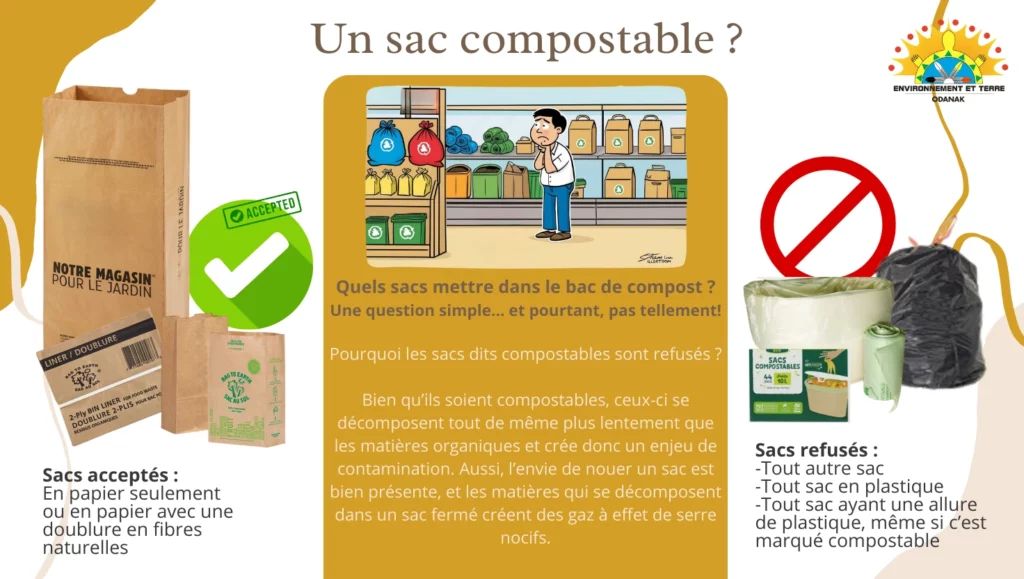
The answer is yes — but only paper bags. However, there is no requirement to use bags at all; in fact, it’s even better not to use them and simply rinse your kitchen caddy.
Key points on whether to use bags:
- The simplest option: put accepted materials directly into the brown bin, WITHOUT A BAG.
- Use what you have to line or cover the bottom of your container: flyers, newspapers, sawdust, brown paper bags, cardboard (not waxed, without tape and/or staples).
- Avoid any bag that looks like plastic, even if it is labelled compostable.
- Never, ever: regular plastic bags, “biodegradable” or “oxo-biodegradable” bags.
- If you absolutely insist on using store-bought bags, they must always be paper, such as Bag-to-Earth bags, which are leak-resistant.
Details:
Plastic bags or bags that look like plastic unfortunately have no place in the brown bin. By “look like plastic,” we mean plant-based cellulose bags. Although they are labelled “compostable” and even certified by BNQ and BPI, in practice they break down much more slowly than the food scraps inside them. Furthermore, when tied shut, the scraps inside may decompose without oxygen, producing methane — a major greenhouse gas that contributes to climate change.
At the composting facility, a visual sort — human or robotic — is carried out, and these bags are discarded, whether empty or full. They are currently considered contaminants for compost. Their presence in compost is counterproductive: they slow down the composting process and risk producing unwanted gases, which is one of the main reasons we encourage people to compost in the first place.
However, there are paper bags with a cellulose lining that reportedly break down well (certified by BPI and BNQ) as well as “double-ply” bags. The BAG-TO-EARTH brand is recommended and can be found in large retail stores and hardware shops. Other companies make similar products, but avoid sealing the bags with adhesive strips when provided.
Cellulose-lined bags: see an example.
Double-ply bags: see an example.
These bags can be costly, so here are some cheaper alternatives:
For your kitchen caddy:
- If you have them on hand, wrap scraps in flyers or newspaper — especially meat, poultry, fish, and very wet scraps — OR line the bottom of the caddy with flyers, alternating layers of scraps and paper.
- Use thin brown paper bags (like “sandwich bags”) or brown paper takeaway/ grocery bags. Just be sure to remove any staples.
For your outdoor brown bin:
- After collection, place a large 110 L brown paper bag (the same as for fallen leaves) inside the bin for your accepted scraps. You can also place clean cardboard at the bottom of the bin (not waxed, not laminated, without staples or tape).
I have bad odors and/or worms in my bin, what should I do?
- Keep your bin in the shade;
- Place a piece of cardboard at the bottom of your brown bin and add newspaper or other leftover brown paper between deposits of food scraps;
- Wrap smellier or wetter scraps in a paper bundle;
- Rinse your bins regularly with water and vinegar;
- Avoid excess liquid;
- Sprinkle baking soda or lime in your bin from time to time;
- Keep the lid closed;
- Put your bin out at every collection, even if it isn’t full;
- Empty your kitchen caddy into the outdoor bin regularly;
- If you have space, you can keep certain scraps in the fridge or freezer and place them in the bin the night before collection.
If you already have maggots in your bin, use coarse salt and vinegar to remove them. Rinse your bin thoroughly afterwards.
A material is compostable AND recyclable, which bin should it be placed in?
This question generally applies to paper and cardboard materials. Indeed, an egg carton or brown paper is both recyclable AND compostable.
So, the answer?
It depends on whether the material is soiled or not. If it is clean, put it in recycling. If it is soiled (grease marks, food residue, etc.), put it in compost.
What happens to my waste once it has been collected by the truck?
The compost collected in Odanak is sent to the Gaudreault composting facility in Saint-Rosaire. It undergoes a windrow composting process, where the piles are mechanically turned in an open-air setting. Turning the organic materials during decomposition ensures the presence of oxygen — a major difference from landfilling, where materials break down without oxygen. This difference is important because oxygen prevents the production of harmful greenhouse gases such as methane. Once decomposed, the organic matter is transformed into compost that is used to enrich soils.
I don't want to compost, it puts me off, I don't like brown... what should I do, can I return my bin?
It is not possible to return a bin. Composting is a social responsibility for future generations. Composting is a healthy way to manage waste, just like using the blue bin for recycling and the black bin for final waste. To get started with composting, begin slowly with simple and intuitive materials such as garden waste. In the kitchen, start with foods that don’t have strong or sweet odors (vegetable peels and scraps). Then gradually introduce other materials as you become familiar with what is acceptable. Position your bucket and bin for easy access. Changing a habit can take time, so don’t put too much pressure on yourself and start gradually. Every little effort counts 🙂
What should I do if I want to obtain a brown bin or a bucket?
Contact us to obtain a second rolling bin for approximately $120.
What should you do if the filter on top of the bucket comes off or is no longer clean?
You can reattach it, secure it with Velcro, or obtain a new filter free of charge by contacting us. It is also possible to obtain a cover without a hole or filter.
Learn more about grasscycling and leafcycling
Try leaving grass clippings on your lawn. This technique reduces the amount of work you have to do and provides your lawn with lots of nutrients. It is also possible to mow fallen leaves in the fall!
For these practices to work well, it is recommended to have a mulching blade on the mower and to mow regularly: avoid having excessively long grass and mow fallen leaves as soon as there are enough of them to make it worthwhile. A layer of fallen leaves that is too thick (especially if wet and compacted) will hinder shredding. In the end, it’s much less work!
What if I already compost at home?
Good news, you already know how to compost! Certain types of waste should be avoided in home composting (meat, poultry, rhubarb, etc.), but these can go in the brown bin. You may also sometimes have too much garden waste for your home compost, so you can put it in the brown bin.
What can be done to keep small animals away?
You can apply a little cough ointment around your tank or on the ventilation holes.