
Odanak Eco-Center

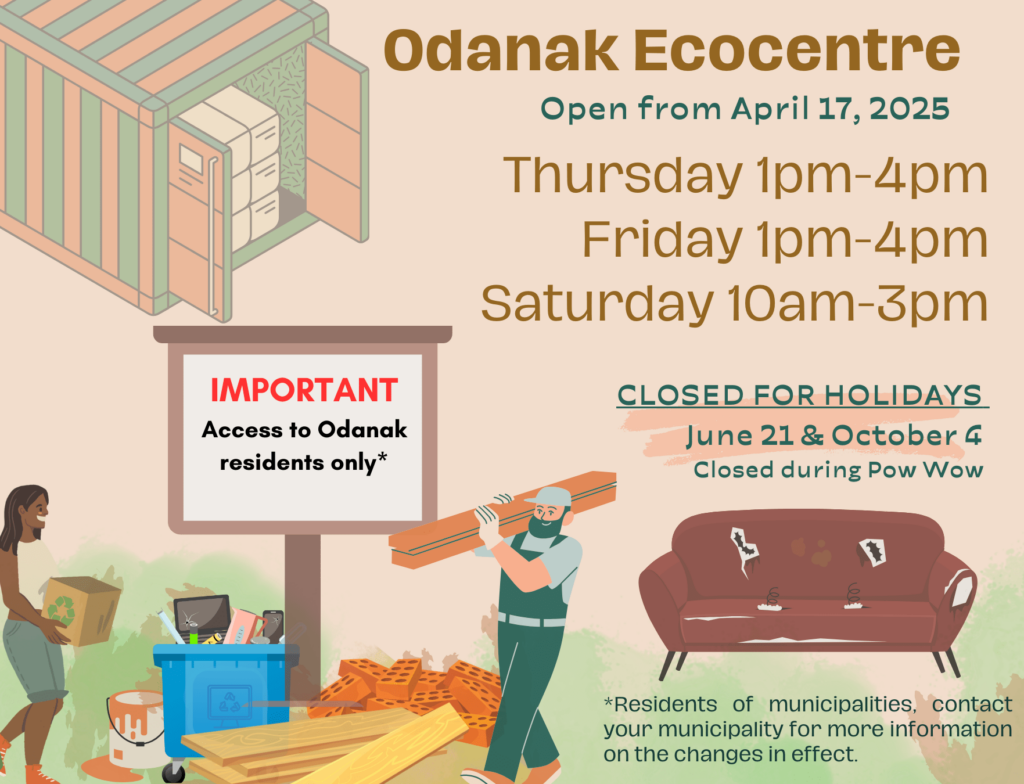
Public Holidays
| Mon | Tue | Wed | Thu | Fri | Sat | Sun |
|---|---|---|---|---|---|---|
|
31
|
1
|
2
|
3
|
4
|
5
|
6
|
|
7
|
8
|
9
|
10
|
11
|
12
|
13
|
|
14
|
15
|
16
|
17
|
18
|
19
|
20
|
|
21
|
22
|
23
|
24
|
25
|
26
|
27
|
|
28
|
29
|
30
|
1
|
2
|
3
|
4
|

ATALIKW8ZAKAMEK
User Regulations
- Use of the Odanak eco-center is reserved for residents of Odanak.
- It is prohibited to use the eco-center outside of opening hours.
- Users must park their vehicles at the reception area and identify themselves with an official document showing their address.
- Users unload their own vehicles in the order in which they arrived and/or according to the attendant's instructions.
- It is prohibited to use machinery or a tipper trailer to unload containers.
- It is prohibited to detach the safety railing and climb into the container.
- Hazardous industrial products are not accepted at the eco-center, and hazardous products that are accepted must be brought in their original container or in a clearly labeled container with a capacity of 20 liters (five gallons) or less.
- Smoking is prohibited on the premises under all circumstances.
- The speed limit on the site is 10 km/h.
- Young children and animals must remain inside vehicles.
- Hunting is prohibited on the site.
- Oversized items must be disassembled or cut.
- Institutions, businesses, industries, and contractors are not permitted to use the eco-center. Certain exceptions may be eligible for a waiver, which must be discussed in advance with the eco-center manager or CAO senior management.
Examples requiring a written waiver or agreement
- Third parties (individuals or companies) transporting materials on behalf of a resident of Odanak or one of the municipalities (e.g., 1-800-GOT-JUNK)
- Municipal public works departments
- Odanak residents with special needs
Contact information Ecocentre
Accessibility
L’écocentre est situé au 2035 rue Tolba, Odanak, J0G 1H0.
L’usage d’un GPS pourrait vous faire passer par un chemin erroné donc suivez les indications suivantes.
Sur la route 132 prendre l’embranchement de la rue Asban (rang Saint-Joseph) qui est à gauche aprés le Marché 132 lorsqu’en direction est ou à droite, 100 m aprés le Dépan-O-Gaz Nimôwon lorsqu’en direction ouest. Sur la rue Asban, continuer 800 m et tourner à gauche sur la rue Tolba. L’entrée de l’écocentre se trouve à la fin du nouveau segment de la rue Tolba.
L’utilisation de l’itinéraire illustré sur la carte ci-dessous et décrit ci-haut est applicable et obligatoire pour tous les usagers.
List of accepted materials

Hazardous household waste
The following electronic products are accepted in unlimited quantities, but must not have been cannibalized or dismantled under any circumstances.
Examples: televisions, recorders, cell phones, tablets, computers, electronic wiring, speakers, audio systems, Christmas lights, etc.
Electronics
The following electronic products are accepted in unlimited quantities, but must not have been cannibalized or dismantled under any circumstances.
Examples: televisions, recorders, cell phones, tablets, computers, electronic wiring, speakers, audio systems, Christmas lights, etc.
Used Glasses
All eyeglass frames, with lenses, whether corrective or not.
Upholstered Furniture
Mattresses, sofas, couches, futon cushions, etc.
Reuse
Furniture and items in good condition intended for reuse, household products and other items that have never been opened. Clothing in good condition should be sent to a charity that can accept it; it will not be accepted at the eco-center.
Tires
Types of tires accepted: Cars, pickup trucks with a diameter of less than 48 inches.
Oversized tires, tracks, ATV tires, truck tires, loader tires, mats, and other items made of rubber are not accepted, but the Odanak Environment and Land Office can provide you with contacts to help you dispose of them.
Building materials, renovation, and demolition
Gypsum, glass, mineral wool, shingles, peel, mixed materials, plastic, and certain oversized items (bathtubs, showers, furniture, pool liners), etc.
Wood
Accepted types of wood: Construction wood, painted wood, wooden furniture, melamine-coated wood, particleboard, compressed wood, plywood.
Creosote-treated wood is not accepted.
Metal
Metals (ferrous and non-ferrous; no quantity limits).
Scrap metal, tools, household appliances, anything that is more than 50% metal.
Appliances containing refrigerant gases
Refrigerators, air conditioners, freezers, dehumidifiers, electric coolers, etc.
Aggregates
Deposit separately:
• Sand
• Gravel (0–3/4″)
• Stones (1″–12″)
• Stones (12″ and over)
• Brick–concrete–ceramic
• Asphalt
Organic Residues
Garden waste, grass clippings, branches, stumps, soil, excavated material, etc.
Expired or unusable child car seats
Prohibited Materials
• All hazardous materials and products from industrial, commercial, or institutional activities;
• Weapons and ammunition;
• Picric acid (used in the manufacture of explosives);
• Hydrofluoric acid (used for treating and cleaning metal surfaces, aluminium production, polishing/etching/matting glass, ceramics, and silicon, manufacturing rust-removal detergents for clothing);
• Asbestos in any form;
• PCB (polychlorinated biphenyl) and any product that may contain it (used as insulating fluids in transformers and capacitors, as heat exchangers, and in various other specialised applications until the late 1970s);
• Creosote-treated or tarred wood (wood containing tar such as telephone poles or railway ties);
• Cyanide in any form (used in chemistry and in mining extraction processes);
• Biomedical waste (syringes, catheters, animal carcasses);
• Pathological waste and radioactive waste;
• Household garbage;
• Contaminated soil (e.g., fuel);
• Thorium nitrate (former gas mantles, certain TIG welding electrodes);
• Clothing (in good or poor condition);
• Certain complex items such as hot tubs (jacuzzis) and structures not separated by material type (e.g., an entire shed);
• Invasive exotic plants, such as Japanese knotweed and phragmites.