Sick Trees Program

Diseased Tree Management Program in Odanak
The Odanak Abenaki Council has implemented a program to assist property owners in managing diseased trees, with a particular focus on ash trees affected by the emerald ash borer. The program offers free ash tree assessments and necessary interventions, including treatments, felling, planting replacement trees, and follow-up. This program meets several objectives, such as:
- Ensuring public safety by reducing the risk of falling branches.
- Preserve the environment and the ecological services provided by mature trees, such as soil stabilization and enrichment, as well as support for biodiversity.
- Limit the spread of the emerald ash borer in the Odanak Territory.
- Maintain the aesthetics of the landscape and the quality of the tree cover.
These conservation efforts are part of an approach to protect and promote the black ash tree, a tree that is essential to the community’s identity and traditional skills, and part of a strategy to adapt to climate change by focusing on nature-based solutions.
Impact of the Emerald Ash Borer on Abenaki culture
The emerald ash borer is an Asian beetle that arrived in North America in the early 2000s. It attacks all species of ash trees, threatening the black ash, a tree that is emblematic of the nation and essential to cultural basket weaving practices. The black ash stands known to the community are now severely degraded and cannot be saved. However, several white and red ash trees have been treated through this support program. Although these species are not suitable for basketry, they contribute to the richness of the landscape and the identity of the community, both on private land and near the dock at Marais 1.
Approach
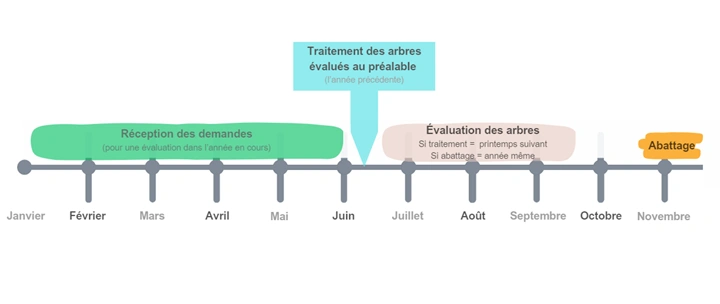
Owners who have ash trees on their property must submit a request to the Odanak Environment and Land Office, by email or telephone, before June 30 for treatment during the summer. The team responsible will first schedule an assessment of the tree between July and September. This assessment will take into account several criteria, including the diameter of the trunk, the presence of signs and symptoms of decline, and the location of the tree.
If an intervention is recommended following the assessment, it is covered at no cost to the owner and may include, if applicable:
Tree Treatment1
Scheduled for the spring following the evaluation.
1 Treatments must be renewed every two years. Once the process is initiated, the responsible team ensures the necessary follow-up.
Or
Tree Felling
If necessary, scheduled for the fall following the assessment, with the planting of a replacement tree (150 cm in height), suited to the site conditions, in the spring following the felling.
Then,
Monitoring of the treated tree or the newly planted tree.
In some cases, maintaining the status quo may be recommended if the tree is still too young for treatment. Before any intervention, the owner is informed of the process and their consent is required.
Other Diseased Trees
This policy may also apply to other species vulnerable to known diseases (American beech, American elm, etc.), subject to a specific assessment.
What the Program Does Not Cover
Some situations are not covered by the program, for example:
- Healthy trees with no known risk of disease or infestation.
- Healthy trees that the owner wishes to remove for aesthetic or functional reasons (e.g., too close to a building or infrastructure).
- Trees showing minor signs of disease, with no risk to public safety and/or the environment.
In all cases, it is the case-by-case assessment by the responsible team that determines whether an intervention is eligible.
For more information, to request an assessment, or to report a diseased tree, contact the Odanak Environment and Land Office.
For more information, to request an assessment, or to report a diseased tree, contact the Odanak Environment and Land Office.
TreeAzin Treatment: A systemic insecticide made from neem tree extract, injected into the trunk, where it circulates to disrupt the growth of emerald ash borer larvae and limit their reproduction. Effective for two years, it is applied to healthy ash trees (less than 30% decline, DBH ≥ 15 cm).